Affiliate disclosure: Fit Scout HQ is reader-supported. Some of the links below are Amazon affiliate links, meaning we may earn a small commission if you buy through them — at no extra cost to you. We only recommend gear we’d use ourselves. Last updated April 2026.
How to Fix Tight Hip Flexors (Step-by-Step)
If you sit for work, drive a lot, or train legs hard, your hip flexors are probably screaming at you — even if you don’t notice it yet. Tight hips quietly wreck your squat depth, your running stride, and your lower back. The good news? You can actually fix this without a chiropractor on speed dial.
This guide breaks down how to fix tight hip flexors with a clear, repeatable routine: release the tissue, lengthen it with smart stretches, then re-train the muscles around it so the tightness doesn’t come right back. Each step tells you exactly what to do and which gear earns its place in the rotation.
Why hip flexors get tight in the first place
Your hip flexors are a small group of muscles — mainly the psoas, iliacus, and rectus femoris — that lift your thigh toward your torso. Sit in a chair eight hours a day and those muscles spend the whole shift in a shortened position. Over weeks and months, they adapt to that shortened length and stop releasing on demand.
Three big triggers show up over and over:
- Prolonged sitting at a desk, in a car, or on a couch
- Weak glutes, which force the hip flexors to overwork as primary movers
- High-volume leg training without matching mobility work
When the hip flexors are chronically short, they tug your pelvis into an anterior tilt. That tilt compresses the lumbar spine, kills your glute firing pattern, and makes hinging or sprinting feel awkward. So “tight hips” isn’t just a flexibility issue — it’s a chain reaction.
The 6-step plan to fix tight hip flexors
Here’s the order I run with clients (and on myself after a full day of writing). Each step builds on the one before it, so don’t skip ahead.
Quick comparison: gear used in this routine
| Tool | Best For | Step | Skill Level |
|---|---|---|---|
| PSO-RITE Psoas Release Tool | Direct psoas / hip flexor pressure | Step 2 | Intermediate |
| TriggerPoint GRID Foam Roller | Quads, glutes, TFL release | Step 2 | Beginner |
| Kieba Lacrosse Balls (Set of 2) | Trigger points in glutes / TFL | Step 2 | Beginner |
| Theragun Mini (3rd Gen) | Quick percussion before stretching | Step 2 | Any |
| BalanceFrom 1/2” Yoga Mat | Floor cushioning for stretches | Step 1 | Beginner |
| Gradient Fitness Stretch Strap | Deeper, assisted hip flexor stretches | Step 3 | Any |
| Fit Simplify Loop Bands (Set of 5) | Glute activation drills | Step 4 | Any |
Step 1: Set up a recovery surface that doesn’t fight you
Before anything else, you need a non-slip surface that cushions your knees and pelvis. Trying to do a couch stretch or kneeling lunge straight on hardwood is how minor tightness becomes an actual injury. A half-inch yoga mat is the floor for everything that follows in this guide.
I’ve burned through a few cheap mats. The BalanceFrom GoYoga All-Purpose 1/2” Yoga Mat is the one I keep coming back to — thick enough that kneeling stretches don’t bruise your knees, but light enough to roll up and stash behind a door. The double-sided non-slip surface holds the floor even on hardwood, which matters when you’re hinging into a deep stretch.
Related read: Building a recovery setup from scratch? Our Best Fitness Recovery Gear on Amazon roundup covers the wider toolkit beyond just hip work.
Step 2: Release the tissue before you stretch it
Stretching cold, locked-up tissue is like trying to pull a frozen rope — you’ll get nothing but discomfort and zero range gained. Spend 5–8 minutes releasing the muscle first, then stretch. This single sequencing change is what turns “my hips never loosen up” into measurable wins.
Direct psoas release
The psoas sits deep behind your abdominal wall and connects to your lumbar spine. You can’t reach it well with a foam roller, and most lacrosse balls roll out from under your bodyweight. The PSO-RITE Psoas Release Tool was built for exactly this job — it’s shaped like a therapist’s elbow and stays put on the floor while you lower your bodyweight onto it.
Lie face-down, place one peak of the PSO-RITE just below your hip bone (about 2–3 inches inward and 2 inches down from the front of your pelvis), and breathe into it for 30–60 seconds. It’s intense the first few times. Start with shorter holds and work up.
Foam roll the supporting cast
Tight hip flexors rarely travel alone. Your quads (especially the rectus femoris, which crosses the hip), glutes, and TFL all pull into the same dysfunction. A solid foam roller handles the larger surfaces in 3–4 minutes.
The TriggerPoint GRID 1.0 earned its spot in my routine by being firm without being punishing. The patented multi-density surface mimics a therapist’s hands — some sections roll like a flat palm, others bite like fingertips. Hit your quads from hip to knee, then flip and target each glute for 60–90 seconds.
Trigger point work for the spots a roller can’t reach
The TFL (tensor fasciae latae) sits on the outside of your hip and cranks your hip flexors when it’s angry. A foam roller smears across it; a lacrosse ball pins it down. The Kieba Massage Lacrosse Balls are dense rubber and small enough to dig into the side of your hip and the deep glute region. Two minutes per side is plenty.
Optional: percussion for time-crunched mornings
If you’ve only got six minutes before work, a percussive massage gun does in 90 seconds what a foam roller does in three minutes. The Theragun Mini (3rd Gen) is the pick I keep recommending for travel and tight schedules — it’s palm-sized, runs up to 180 minutes per charge, and has just enough power to break up superficial tension in the quads, glutes, and front of the hip without overdoing it.
Run it for 30 seconds along the front of each hip and 30 seconds across each glute. Don’t hammer the same spot — keep the head moving.
Step 3: Stretch with intent (not vibes)
Once the tissue is awake, you can finally lengthen it. Two stretches do most of the work for hip flexors. Skip the half-hearted standing quad stretch — it doesn’t target the psoas at all.
Half-kneeling hip flexor stretch
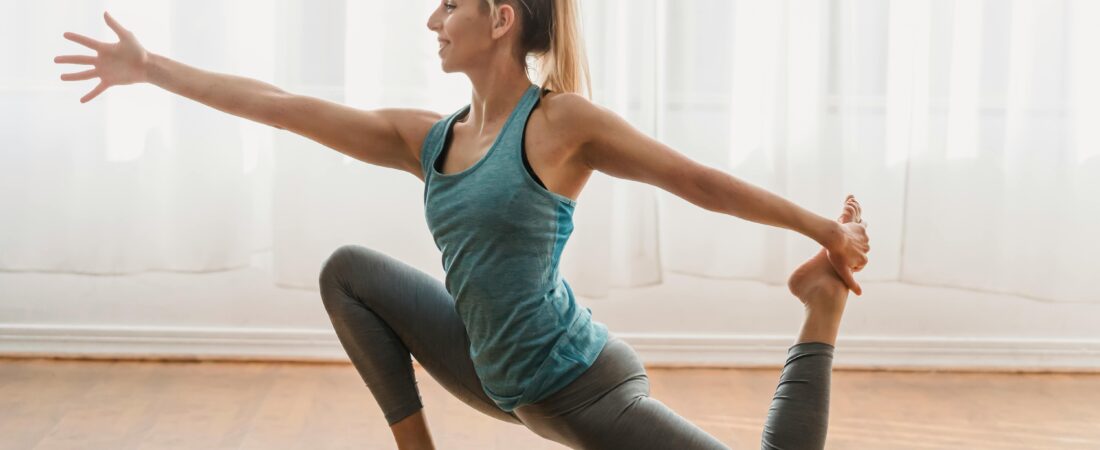
Drop into a half-kneeling lunge with your back knee on the mat. Squeeze the glute on your back leg, tuck your tailbone slightly under (this is the part most people skip), and lean forward from the hip — not the lower back. Hold for 60–90 seconds per side. You should feel it deep in the front of the hip on the kneeling leg.
Couch stretch (the gold standard)
This one’s brutal but effective. Place your back foot up on a couch or bench with the shin against the cushion, your front foot planted, and slowly raise your torso upright. Tuck your tailbone and squeeze your back glute. Two minutes per side, three to four times a week, will rewrite what your hips can do.
Use a strap to deepen the stretch
Once those two feel manageable, a stretching strap helps you push past the easy range and into the territory where actual gains happen. The Gradient Fitness Stretching Strap has 12 separate loops, so you can lock your foot into a fixed length instead of fighting your grip the whole time. I use it for supine 90/90 stretches and assisted couch stretches.
Step 4: Wake up the glutes — or this all unravels
Here’s where most people lose the long game. You can release and stretch every day, but if your glutes don’t fire properly, the hip flexors keep getting recruited as primary movers and stay short. You have to give the glutes their job back.
Two drills, three sets each, daily for the first two weeks:
- Banded glute bridges: Loop a light band just above your knees, lie on your back with feet flat, and drive your hips up while pressing your knees outward. 12 reps.
- Banded clamshells: Side-lying with knees bent and the band above your knees. Open the top knee while keeping your feet together. 15 reps each side.
The Fit Simplify Resistance Loop Bands (Set of 5) are the easiest entry point here. You get five tension levels, so you can start with the lightest band and progress as the glutes wake up. Same set works for monster walks, lateral steps, and a dozen other drills.
Want to take glute training further? Check our deeper breakdown of the Best Equipment for Glute Workouts — the right hip thrust setup is a game-changer once your hips can actually extend.
Step 5: Fix what got you here in the first place
Routines fix the symptom. Habits fix the cause. If you sit eight hours a day and never break it up, your hip flexors will tighten right back up by Wednesday. A few small changes move the needle:
- Stand or walk for 2–3 minutes every 30 minutes. Set a timer if you have to.
- Walk 7,000–10,000 steps a day. Walking is the cheapest hip flexor reset on the planet.
- Train your posture. An anterior pelvic tilt makes hip flexor tightness chronic, no matter how much you stretch.
Posture is half the battle. Our Best Posture Correction Equipment guide covers the gear that actually helps desk workers stay tall — and keeps the hip flexors from regressing.
Step 6: Build it into a 10-minute daily routine
Here’s the whole thing as a daily flow you can run before training, after work, or first thing in the morning:
- 0:00–1:00 — Foam roll quads (30s each side)
- 1:00–3:00 — PSO-RITE psoas release (60s each side)
- 3:00–5:00 — Lacrosse ball on glutes / TFL (60s each side)
- 5:00–7:00 — Half-kneeling hip flexor stretch (60s each side)
- 7:00–9:00 — Couch stretch (60s each side, work up to 2 min)
- 9:00–10:00 — Banded glute bridges (12 reps) and clamshells (15 each side)
Run this five days a week for three weeks. You’ll notice deeper squats, less low-back stiffness in the morning, and a faster stride if you run.
Frequently asked questions
How long does it take to fix tight hip flexors?
Most people feel meaningful change within 2–3 weeks of daily work. Real structural improvement — the kind that holds when you stop — takes 8–12 weeks of consistent release, stretching, and glute strengthening combined.
Can you fix tight hip flexors without any equipment?
Yes, partially. Bodyweight stretches like the half-kneeling hip flexor stretch and couch stretch get you maybe 60% of the way there. Adding a foam roller, a release tool for the psoas, and resistance bands for glute work covers the other 40% — and that’s the part that makes the change stick.
Should you stretch hip flexors every day?
Daily light stretching is fine and often helpful. Hard, end-range stretching is better in 4–5 sessions per week so the tissue can adapt. The release work (foam rolling, PSO-RITE) can be done daily without issue.
Does sitting really cause tight hip flexors?
Yes. When you sit, your hip flexors are in a shortened position for hours at a time. Over weeks and months, the muscle fibers and surrounding fascia adapt to that shortened length. That’s why sedentary workers report tight hips far more than active ones.
Are massage guns better than foam rollers for hip flexors?
Different tools, different jobs. A massage gun like the Theragun Mini delivers fast, targeted percussion that’s great pre-workout or when you’re short on time. A foam roller covers more surface area and lets you use bodyweight for deeper pressure. The best routine uses both.
Can tight hip flexors cause lower back pain?
Often, yes. When the hip flexors stay short, they pull the pelvis into anterior tilt, which compresses the lumbar spine and overworks the lower back muscles. Loosening the hip flexors and re-engaging the glutes is a standard intervention for non-specific lower back stiffness.
The bottom line
Fixing tight hip flexors isn’t about finding the one perfect stretch. It’s about running the right sequence — release, stretch, strengthen, then fix the daily habits that caused the problem. Ten minutes a day is enough if you’re consistent. The gear above just makes each step faster and more effective.
If you’re building out a broader recovery and home gym setup, our Best Beginner Home Gym Setup guide pairs naturally with this routine. And if leg day keeps leaving you stiff, our Push Pull Legs Routine shows how to program the work without overcooking your hips.
Note: Every Amazon link in this guide uses Fit Scout HQ’s affiliate ID. Stock and pricing on Amazon change frequently — we recommend confirming availability before checkout.