Disclosure: FitScoutHQ is reader-supported. Some links below are Amazon affiliate links, which means we may earn a small commission when you buy through them — at no extra cost to you. We only recommend gear we’d actually use ourselves.
You crushed squats. You walked out of the gym feeling like a champion. Then morning hits — and the stairs feel like Everest. A solid post-workout stretch routine for leg day is the difference between bouncing back tomorrow and limping for three days. Done right, it pulls fresh blood through fatigued tissue, calms the nervous system, and protects the range of motion you just spent an hour earning under the bar.
This guide walks through a seven-move routine that targets every major muscle you hammered — quads, hamstrings, glutes, calves, hip flexors, and adductors. We’ll also cover six pieces of recovery gear that genuinely upgrade the experience, each verified for current stock and worth the spend. Skip what you don’t need; grab what fits your setup.
Why a Post-Workout Stretch Routine for Leg Day Actually Matters
Heavy compound work shortens muscle fibers under repeated load. Your hamstrings tighten, your hip flexors stiffen from all that depth in the squat, and your calves carry the leftover stress of every step you took on the platform. Skipping the cooldown doesn’t just leave you sore — it teaches your body that “tight” is the new neutral.
Static stretching held for 30 to 60 seconds per muscle, paired with light myofascial work, has been shown to reduce delayed onset muscle soreness and restore baseline flexibility within 24 hours. The American College of Sports Medicine recommends including flexibility work after resistance training to support recovery and long-term joint health. Translation: those ten minutes you skip are doing real work.
Recovery Gear at a Glance
| Product | Best For | Why It Earns a Spot |
|---|---|---|
| TriggerPoint GRID Foam Roller | IT band, quads, hamstrings | Multi-density grid mimics a therapist’s hands |
| OPTP Stretch Out Strap | Solo hamstring & calf stretches | 10 sewn loops let you deepen safely |
| Theragun Relief | Tight quads & calves | Light grip, 3 speeds, beginner-friendly |
| BalanceFrom 1/2″ Yoga Mat | Floor stretches without joint pain | Half-inch cushion, non-slip both sides |
| Kieba Lacrosse Balls (2-pack) | Glutes, piriformis, plantar fascia | Pinpoint pressure where rollers can’t reach |
| StrongTek Slant Board | Calves & Achilles | Five angles, 500-lb capacity, real plywood |
The 7-Move Post-Workout Stretch Routine for Leg Day
Run through the sequence below right after your last working set, while muscles are still warm. Hold each static stretch for 30 to 45 seconds per side and breathe slowly — short, sharp breathing fights the relaxation response you’re trying to trigger.
1. Foam Roll Quads (90 seconds per leg)
Lie face-down with the roller across your thigh. Roll slowly from hip to just above the knee, pausing five to ten seconds on hot spots. The quads take the brunt of squats, lunges, and leg presses — give them attention before anything else.
2. Standing Hamstring Stretch with a Strap (45 seconds per leg)
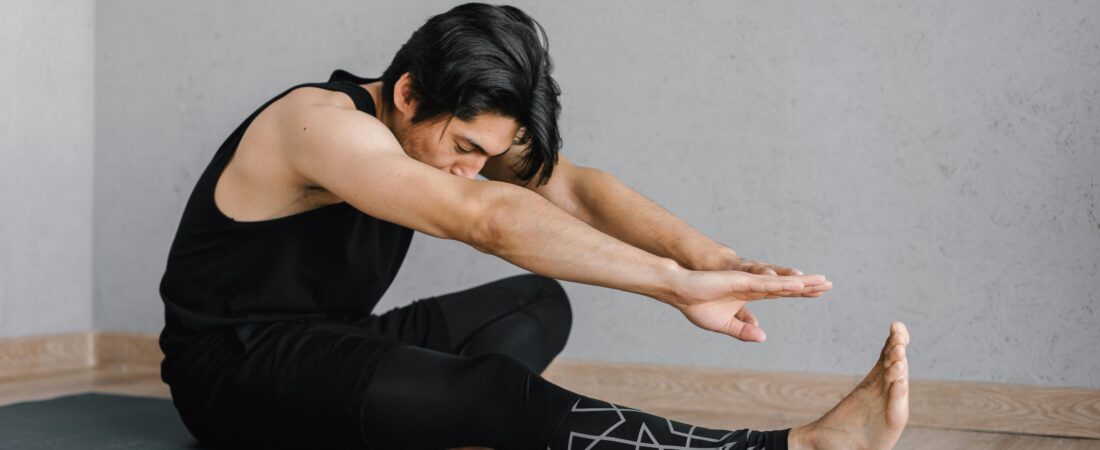
Lie on your back, loop the strap around your foot, and extend the leg toward the ceiling. The strap lets you control depth without rounding your lower back — a common mistake that turns a hamstring stretch into a lumbar pull.
3. Half-Kneeling Hip Flexor Stretch (45 seconds per side)
Drop into a lunge position with the back knee on the mat. Tuck your pelvis under and press the front hip forward. You should feel it deep in the front of the rear hip — not the lower back. Hip flexors lock up after squats more than people realize, and tight ones quietly steal glute activation on every rep that follows.
4. Pigeon Pose for Glutes (60 seconds per side)
Bring one shin forward across the mat, extend the back leg straight behind you, and fold over the front shin. If your glutes are stubborn, place a lacrosse ball under the meaty part of the cheek before easing into the position — game-changer.
5. Standing Calf Stretch on a Slant Board (45 seconds per leg)
Step onto the board with toes up, heels low, and let gravity do the work. A slant board hits the gastrocnemius and soleus far more effectively than the wall stretch most people default to.
6. Butterfly Stretch for Adductors (60 seconds)
Sit tall, soles of the feet together, knees falling open. Lean forward from the hips — not the spine. Adductors get blasted on every wide stance squat and Bulgarian split squat, but they rarely make the cooldown list.
7. Percussion Massage on Quads & Calves (2 minutes total)
Finish with a massage gun on the meatiest parts of the quads and calves. Skip bone, tendon insertions, and the back of the knee. This last step accelerates blood flow and signals “we’re done here” to a fired-up nervous system.
📚 Related read: If you’re rebuilding your full lower body day from scratch, our Push Pull Legs Routine with Adjustable Dumbbells breakdown pairs perfectly with this stretch sequence.
The 6 Gear Picks That Elevate This Routine
1. TriggerPoint GRID Foam Roller — Best Overall Roller
Truth is, most foam rollers go soft after a few months and end up feeling like a pool noodle. The TriggerPoint GRID solves that with a hollow plastic core wrapped in multi-density EVA foam. The textured surface — channels, ridges, and flat zones — replicates the feel of a massage therapist’s hands rather than a uniform tube. At 13 inches, it travels well and handles riders north of 200 pounds without crushing. This is the roller you’ll see in physical therapy clinics for a reason.
2. OPTP Original Stretch Out Strap — Best for Solo Stretching
The OPTP strap launched in 1993 and still leads the category, which tells you something. Ten sewn loops let you ladder progressively into a deeper stretch without yanking — useful when your hamstrings feel like guitar strings after RDLs. Made in the USA from non-elastic woven nylon, it doesn’t stretch back on you, so the position you set is the position you hold. The included exercise booklet covers more than 30 stretches if you want to expand beyond leg day.
3. Theragun Relief — Best Beginner Massage Gun
Therabody’s Relief model strips the percussion gun back to what most people actually use: three speeds, three attachment heads, a triangle grip that doesn’t murder your wrist. It’s lighter and quieter than the Pro, and the gentler amplitude is more forgiving on tight quads that don’t need to be pulverized. Battery runs about 150 minutes, which covers weeks of leg-day cooldowns. If you’re new to percussion therapy, this is the model to start with — full stop.
4. BalanceFrom GoYoga 1/2-Inch Mat — Best Budget Mat
Pigeon pose on a hardwood floor is a punishment, not a stretch. The BalanceFrom GoYoga gives you a half-inch of high-density foam at 71″ x 24″, non-slip on both sides, with a built-in carrying strap. It’s not a fancy rubber studio mat, but it shrugs off heavy use, wipes clean with soap, and has held up across years of Amazon reviews. For a recovery setup, this is plenty — and the two-year warranty backs it up.
5. Kieba Lacrosse Balls (2-Pack) — Best for Trigger Points
A lacrosse ball gets into spots a foam roller never will — the deep glute medius, the piriformis, the bottom of your foot if your calves are wrecked. The Kieba pair is solid rubber, regulation size and weight, and dirt cheap for what they do. Place one against a wall, lean in, and shift weight onto the knot. Fair warning: the first 60 seconds on a tight glute will make you reconsider your life choices. Then everything starts loosening up.
6. StrongTek Wooden Slant Board — Best for Calves & Ankle Mobility
Most lifters underestimate how much tight calves and stiff ankles bottleneck squat depth. The StrongTek board adjusts across five angles up to 35 degrees, supports 500 pounds, and is built from genuine Lauan hardwood plywood — not particle board pretending to be wood. Three minutes per side after leg day on this thing changes how your next session feels. It also doubles as a heel wedge for deeper front squats if you train without lifters.
🔗 Want the full recovery toolkit? Our Best Fitness Recovery Gear on Amazon roundup covers compression boots, ice bath setups, and other tools that pair beautifully with this routine.
How to Build Your Cooldown Habit
The hardest part of any post-workout stretch routine for leg day isn’t the stretching — it’s actually doing it when you’re cooked and the couch is calling. A few tactics that genuinely help:
- Stack it into the workout itself. Treat the cooldown as the last “set” of the day. Walk straight from the squat rack to the mat — don’t sit down first.
- Keep gear visible. A foam roller behind a closet door gets used twice a year. Leave it next to your training space.
- Time-cap it. Ten minutes is enough. Anything longer turns recovery into another chore.
- Pair it with something passive. Stretch while a podcast plays or while protein shakes blend. The dual task makes it feel like nothing.
Glute-Focused Leg Day? Train Smarter, Recover Smarter
If your leg day leans heavy on glute work — hip thrusts, RDLs, sumo deadlifts — your cooldown should reflect that. Pigeon pose, lacrosse ball trigger work on the glute medius, and a long figure-four stretch matter more than another quad roll-out.
👉 Going hard on glutes? See our pick of the Best Equipment for Glute Workouts to match the recovery tools to the training load.
Frequently Asked Questions
How long should a post-workout stretch routine for leg day take?
Ten to fifteen minutes covers the essentials. The seven-move routine above lands at roughly twelve minutes when you hit each side — long enough to make a difference, short enough that you’ll actually do it consistently.
Should I stretch before or after lifting legs?
Save static stretching for after. Holding long stretches before heavy squats can briefly dampen power output. Pre-workout, stick to dynamic mobility drills — leg swings, lunges with rotation, bodyweight squats. The deep static work belongs at the end.
Does foam rolling actually reduce muscle soreness?
Yes, multiple studies show foam rolling immediately post-workout and again the next morning reduces DOMS severity and helps restore force production faster. It won’t eliminate soreness, but it noticeably softens the hit.
Do I need a massage gun if I already have a foam roller?
Not strictly. A foam roller plus a lacrosse ball covers 80% of what most people need. A massage gun shines for targeting smaller, deeper muscles — calves around the soleus, the VMO above the knee — and saves time when you’re short on it. It’s a quality-of-life upgrade rather than a must-have.
Is it normal for stretching to feel painful after leg day?
Mild discomfort and a strong “stretch sensation” are expected. Sharp pain, joint pain, or anything that radiates down a limb is not — back off immediately. Stretching should feel like productive tension, not a warning signal.
Final Word: Make Recovery Non-Negotiable
A consistent post-workout stretch routine for leg day pays compounding interest. Better squat depth next week. Less morning stiffness. Fewer nagging aches that turn into real injuries. The seven moves above plus two or three smart gear picks — that’s the whole formula. Pick one tool to start with (the foam roller or the strap, if you’re stuck choosing), use it after every leg session for two weeks, and notice how different the next workout feels.
Train hard, recover harder. Your future self lifting on Monday morning will thank you.
As an Amazon Associate, Fit Scout HQ earns from qualifying purchases. All product picks reflect hands-on experience and independent research; pricing and availability may change after publication.